AFTERLUMA JOURNAL • CURATED EDITORIAL ARCHIVE
The Crevice Between Us and Space: A Frank Look at the New Tamron 12-20mm F/2.8
There is an old trap in photography: the assumption that ultra-wide lenses exist to 'fit more into the frame.' When you mount a 12mm focal length onto a camera body for the first time, your initial reflex is often to step back, take in the vastness of the sky or the breadth of an urban square, and trip the shutter. The result is almost invariably underwhelming — a cavernous expanse of empty space, a diminutive subject lost somewhere near the horizon, and an unsettling sense of visual detachment.
The reality is quite the opposite. A 12mm focal length is not about width; it is about uncompromising proximity. It is a tool that pulls you directly into the texture of things, compelling you to step forward until the worn bricks or ancient cobblestones lie just a foot from your front glass, orchestrating every square inch of the periphery.
The Wisdom of Practical Engineering and the 67mm Standard
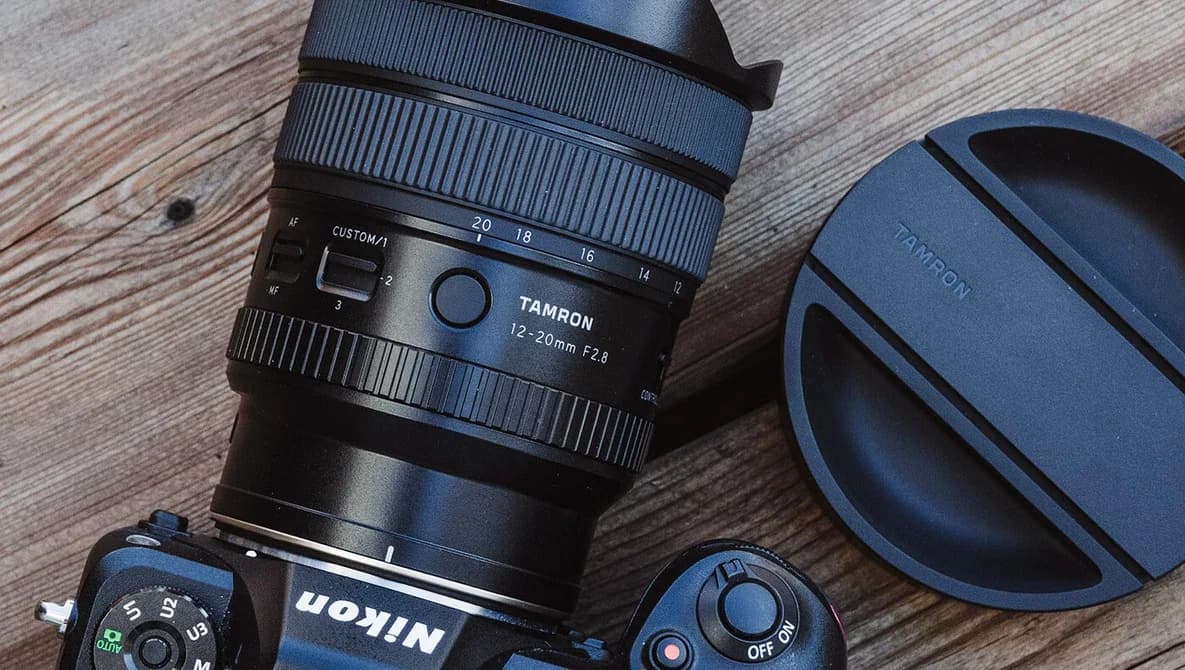
Tamron has maintained a stubborn design philosophy that commands respect: they refuse to manufacture camera lenses like heavy bronze desk ornaments. Holding a 1.2-kilogram hunk of milled brass feels substantial for twenty minutes. After eight hours on foot across damp autumn asphalt, you begin to resent your own craft.
The new 12-20mm F/2.8 is built from satin-finished composite polycarbonate — a material purists occasionally dismiss as 'plastic', yet in the field it carries two decisive advantages:
- It does not freeze your fingers at 5 AM while tracking morning river fog.
- It weighs so little that the camera body remains perfectly balanced in one hand, without nose-diving when slung over your coat.
And then there is the 67mm front filter thread. Tamron has preserved this standard across virtually their entire mirrorless lineup. This means your high-end circular polarizer or variable ND filter from a 28-75mm or 70-180mm threads on directly, without rattling step-up adapter rings lost in deep jacket pockets. For anyone working in the field rather than under studio strobes, that single detail is worth more than any marketing spec sheet.
Constant F/2.8: Beyond Shallow Depth of Field
Much is written about bokeh on wide-angle optics, even though at 12mm or 16mm subject separation is inherently subtle. You do not purchase a fast wide zoom for creamy portrait blur.
You purchase it for two raw, practical imperatives:
- Available Light in Tight Quarters: Stepping inside historic churches or dim museum wings where tripods are strictly prohibited by guards, that extra stop compared to an f/4 zoom translates to ISO 1600 instead of ISO 6400.
- Nightscapes & Astrophotography: At 12mm and f/2.8, you can sustain 20-second exposures under mountain skies without star trailing, drawing out the Milky Way with clean shadow tonality.
Wide open at f/2.8, central resolution is razor sharp from frame one. Extreme edges reveal gentle contrast roll-off and mild natural vignetting — a character I personally favor over aggressive software profiling that boosts corner noise. Stopped down to f/5.6, the frame evens out with immaculate geometric integrity and tactile surface fidelity.
Flare Suppression and Direct Light
With such an expansive field of view, the sun or street lamps inevitably intrude somewhere near the frame edges. Cheaper optics wash out under harsh counter-light, smothering local contrast in a milky haze.
The optical coating on this 12-20mm handles direct glare with admirable maturity. Aimed directly into low autumn sun, minor ghosting may occur, but global contrast holds firm, shadow values stay deep, and light rays coalesce into crisp sunstars when stopped down to f/11 or f/16.
Who Is This Lens For?
This is not a lens for those who wish to sit comfortably on a park bench and observe from safety. A 12-20mm challenges you. It demands that you get your shoes dirty, step into personal space until you catch the subject's eye, and seek unconventional low perspectives that accentuate ground planes and architectural tension.
It is not an untouchable showroom artifact. It is an honest field tool: compact, agile in autofocus, weather-sealed, and ready to be packed alongside a notebook and spare batteries.
And for a journal like Afterluma, where authentic visual narrative always eclipses sterile laboratory perfection, that is precisely the kind of glass we reach for.
Comments & Thoughts
0You must be signed in to join the conversation.
Sign In